How I built a high-performance e-commerce SaaS on top of OpenCart 3 using Gemini AI
Hi everyone! I’m Alex. A few years ago, I left my home country of Ukraine and relocated to Slovakia. For a long time, I worked as a hired employee, but recently I hit a wall of absolute burnout. I was tired of building other people's dreams, so I quit my job to invest everything I knew—HTML, CSS, PHP, and Linux server administration—into my own product: Hostatto.com
My goal was simple but important: to build a platform for creating online stores that delivers maximum speed and high performance without the unnecessary complexity of bloated technologies.
Instead of spending years writing a new e-commerce engine from scratch, I decided to use a battle-tested foundation: OpenCart 3.
To pull this off alone without a team of developers, I hired an AI teammate—Gemini. I acted as the Chief Product Officer, System Architect, and QA engineer, while Gemini generated clean, raw code based on my technical specifications.
Here is how the architecture works under the hood.
The Multi-Tenant Architecture (Single Filesystem, Multi-DB)
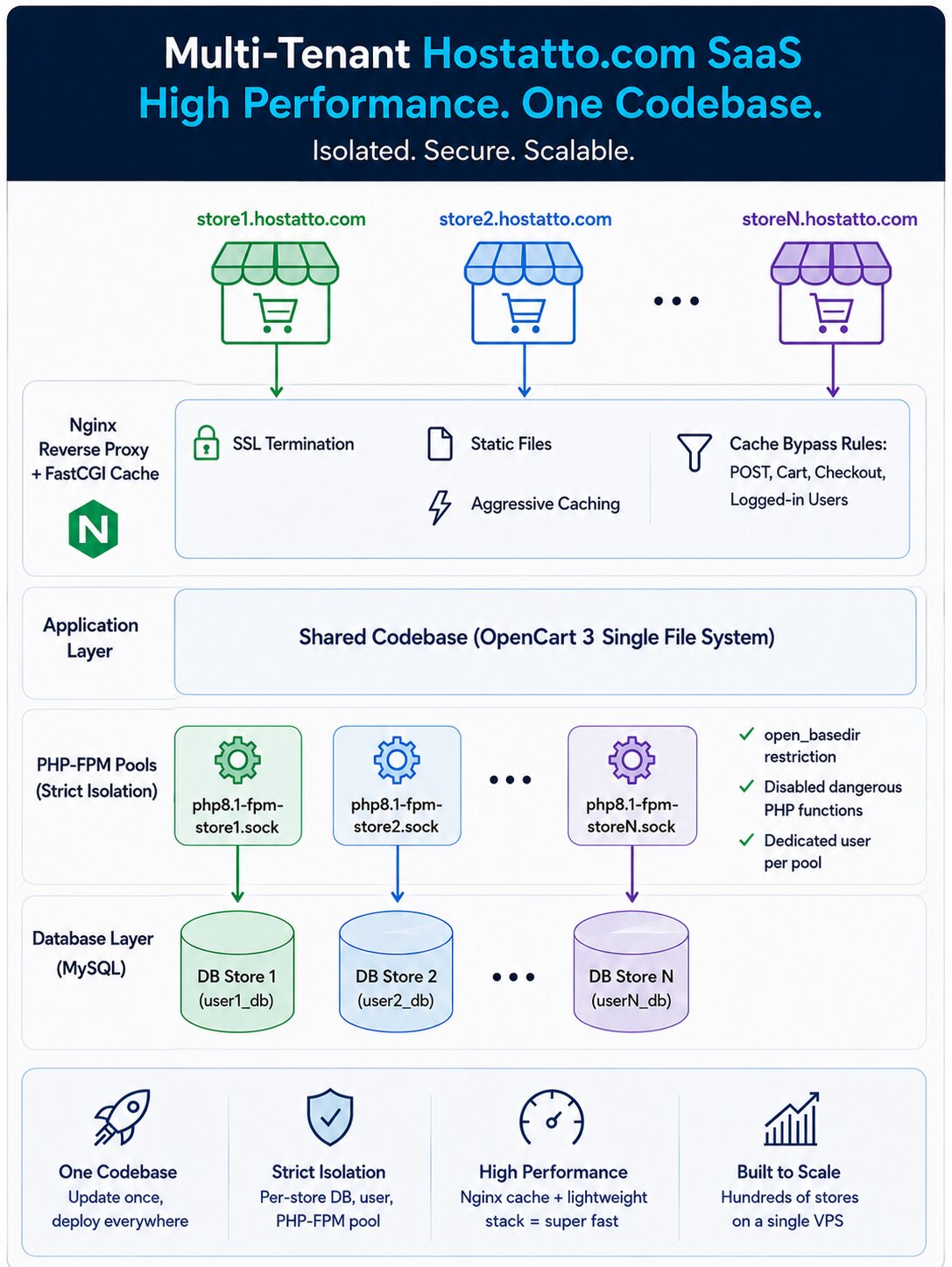
To ensure the system could scale efficiently on a single VPS without eating up server resources, I avoided creating separate copies of the engine for every user.
Instead, I built a system that dynamically provisions environments:
Shared Core: Every single shop on the platform runs on the exact same codebase. When I push an update or fix a bug, it instantly deploys to every user on the platform.
Isolated Databases: The moment a user signs up, a PHP script triggers a background bash routine that safely provisions a dedicated MySQL database and user with a cryptographically secure random password.
Security Isolation: I don't use shared PHP processes. Every store gets its own unique PHP-FPM pool socket (php8.1-fpm-subdomain.sock) with a strict open_basedir restriction and disabled dangerous PHP functions.
Radical Server-Level Performance
Most modern e-commerce platforms are bloated with heavy frameworks. I went old-school for maximum speed:
Vanilla CSS Frontend: I completely bypassed Bootstrap or modern bulky CSS utilities. Instead, I built a lightweight, clean HTML/CSS template and transformed it into a completely new website layout.
Aggressive Nginx FastCGI Caching: The server automatically caches static pages and catalog routes. I configured specific bypass rules— Nginx automatically skips the cache for POST requests, checkout pages, shopping carts, and logged-in customers.
Automated Maintenance & Smart Backups: The system automatically generates configurations for Monit to track pool health. For backups, the platform schedules daily automated tasks to upload compressed store data to Google Drive via rclone. To avoid hitting Google API rate limits during bulk operations, the backup script runs via a randomized Cron delay.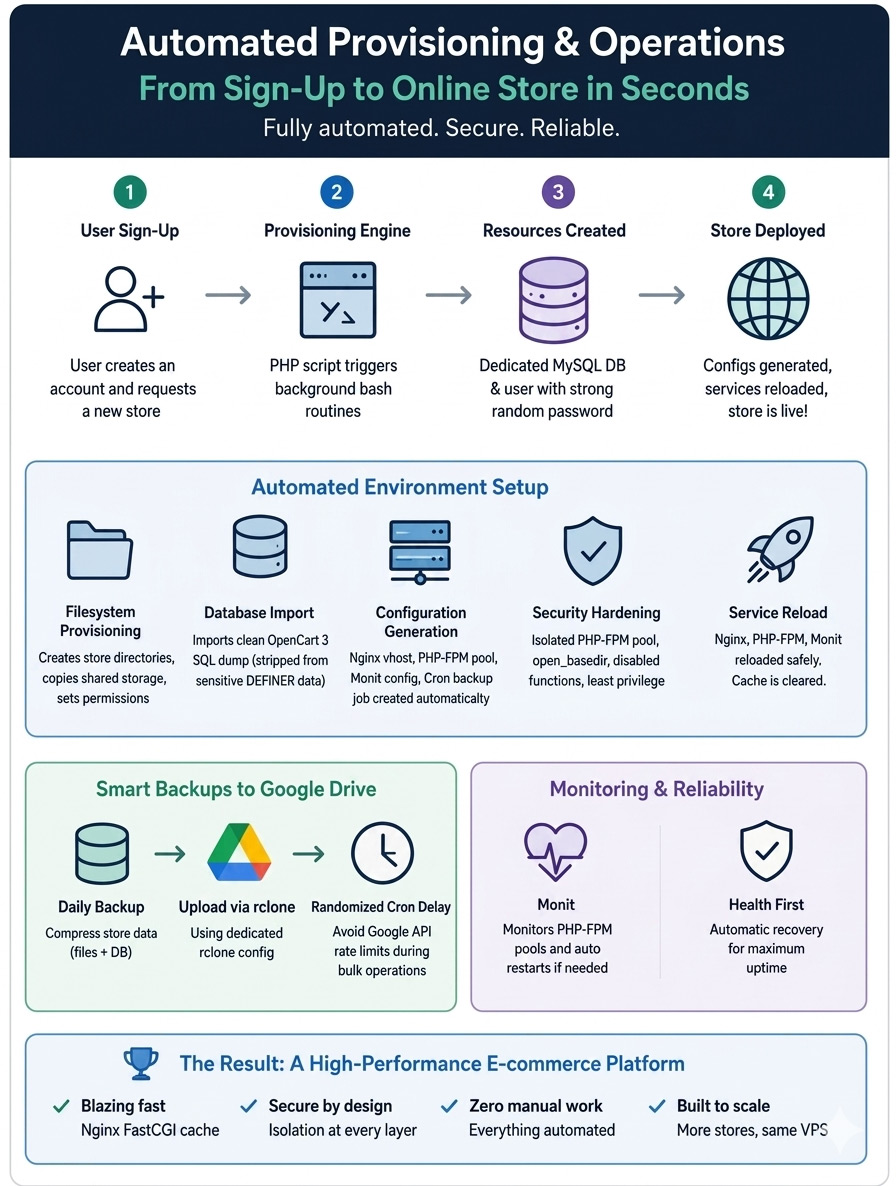
Conclusion
Hostatto.com is a lightweight stack that leverages Nginx FastCGI caching, a shared OpenCart 3 core, and strict PHP-FPM pool isolation, enabling hundreds of lightning-fast online stores to run on a single server. Using Gemini as a true development partner allowed me to design, debug, and implement this entire complex infrastructure efficiently and successfully.
In conclusion, I would like to thank Daniel Kerr for creating OpenCart, and Gemini for helping with code generation and the implementation of this online store builder.